Sometimes the Sidelines are Best

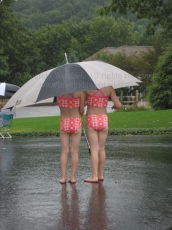
Two years ago my kids swam like stones. Stones both dense and unwieldy in nature. Stones destined for the bottoms of lakes and ponds and pools. And yet, there was an uncanny barnacle-ness about them as well (i.e. they desperately clung to whatever floatation device or seemingly tallish torso that happened to be handy—namely my husband’s or mine). Said buoyancy-challenged individuals were largely comfortable in swimming pools, so long as we stayed in the shallow end and refrained from making any sort of unreasonable requests—like suggesting they loosen their death grip around our necks. Heaven forbid I tuck my hand beneath their bellies and let them kick and flop around in the water like everyone else on the planet with a penchant for becoming guppified.

That said, I’m not entirely sure my kids even wanted to learn to swim—like guppies or anything else equipped with fins and gills. Life was perfectly perfect coiled inextricably around someone’s head, neck and shoulders, their smallish bodies submerged just enough to enjoy a taste of refreshing coolness, while a goodly portion remained above the water’s surface, safe and sound from the terrible, horrible, no good, very bad abyss that surely sought to harm them.

For a time (read: an obscenely large chunk of their lives), we allowed such an idiotic practice to continue, doing our level best to enable our children and to accept the Island of Dependency we had inadvertently become. Of course, we fully expected a miracle to befall us. A miracle that would effectively save us from ourselves. Out of the blue, our charges would suddenly abandon their fears and start swimming like fish or, more correctly, like porpoises, plunging headlong into the murky depths in search of silvery prizes and whatever else they felt inclined to fetch from the deck of the Titanic. Through osmosis, our aquatic wonders would absorb every speck of knowledge and skill I had acquired as a lifeguard, and then some. They’d even be strangely adept at twirling whistles around their fingers and hauling greased watermelons across vast stretches of open water—talents that smack of impressiveness but have yet to be deemed useful.

But it was not to be. Eventually my husband and I faced the cold, hard truth. Hopes and dreams didn’t make good swimmers. Lessons did. Lessons involving a lot of hard work, a boatload of skilled instructors from whom praise flowed endlessly and a vat of courage—mostly of the parental variety. That said, it takes superhuman strength and nerves of steel to sit back idly and watch one’s beloved progeny flap and flounder as he or she goes about the important business of learning how to swim. It’s true: Kids panic. Kids swallow a disturbing amount of water. Kids stare at you from the deep end with horrified expressions of “How COULD you?!” and “Are you really my mother?!”

Not surprisingly, parents twist and turn uncomfortably in their seats, wearing nervous smiles and attempting to chat casually. Yet deep inside—awash with guilt and filled with doubt—they harbor pure and unadulterated torment. Or maybe that was just me, squirming in my lawn chair in a futile attempt to silence the voices in my head that relentlessly screamed, “Your child is DROWNING for Crissakes! And all you can do is swat flies and admire your tanned toes?! What kind of parent are you anyway?! You font of wickedness!” More than anything I felt helpless—almost beside myself with the idea of being on the sidelines.

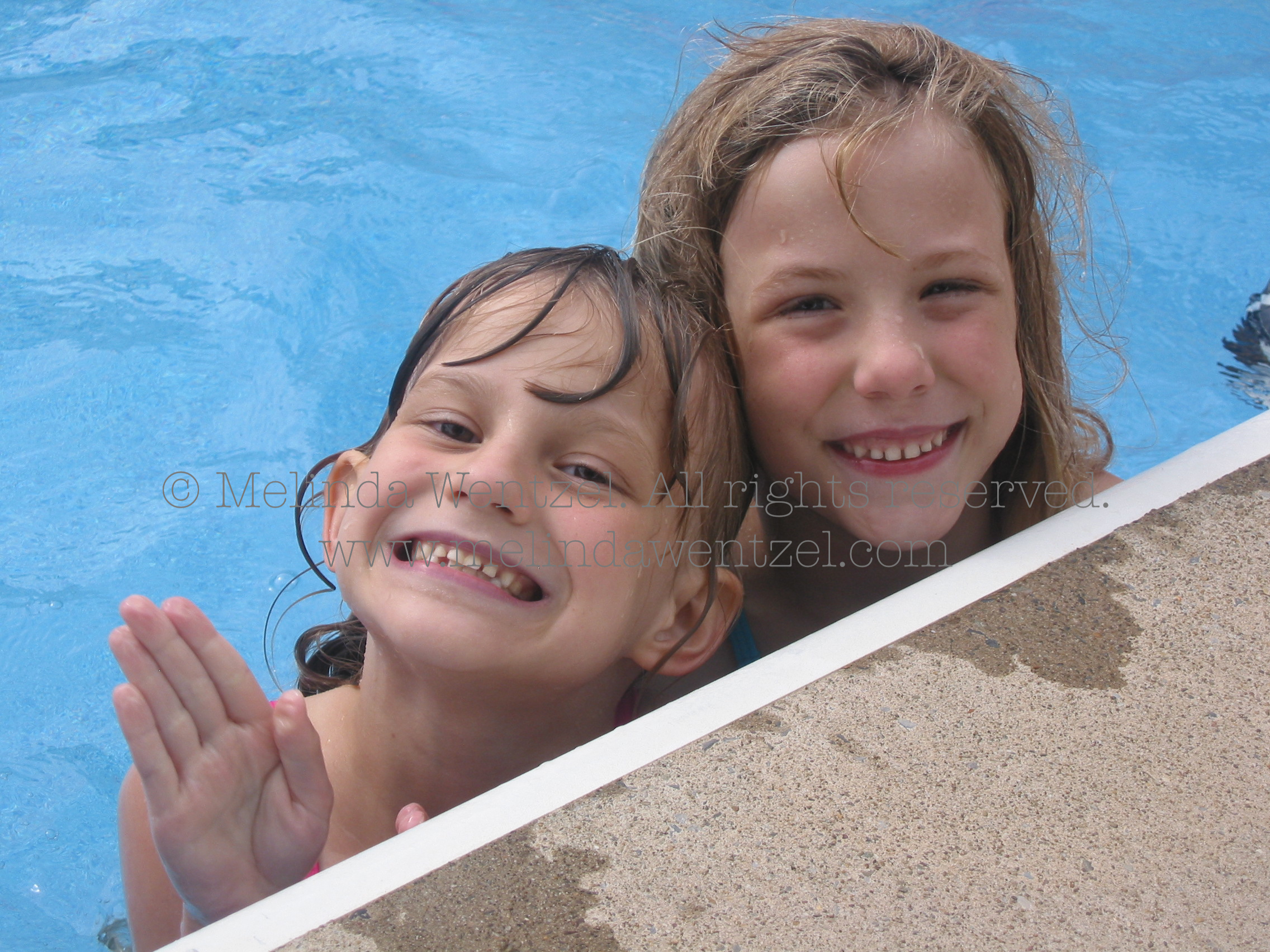
And yet, that was where I needed to be. The place where I was, in fact, most effective. I needed to have faith in the process. Faith in the instructors. Faith in my children’s ability to succeed—in spite of the dearth of achievement I had witnessed thus far. And succeed they did. They’ve ditched the semblance of stones and barnacles for good and have since transformed into more guppy-ish creatures, completely thrilled with their newfound ability to swim, “…even in the deep end, Mom!”

Aside from seeing actual results in the pool, I know this much is true because we’ve progressed from comments like, “I hope you know this is PURE TORTURE, Mom!” to “Can’t you just LEAVE ME HERE so I could swim ALL DAY, EVERYDAY?!”

Yep. Sometimes the sidelines are best.

Planet Mom: It’s where I live (in Guppyville). Visit me there at www.facebook.com/NotesfromPlanetMom.

Copyright 2009 Melinda L. Wentzel

1 Comment

Filed under Endless Summer, Gratitude, I Pretty Much Suck at Parenting, In the Trenches of Parentville, Ode to Embarrassment

The Seven Habits of Highly Defective Parents

Sarcasm aside, Stephen Covey should have written a book with the abovementioned title. Not that he failed spectacularly as a father, but because people tend to more readily grasp what doesn’t work, as opposed to what does. Like tightrope walking, for instance—without a net. In a practical sense, Seven Habits would’ve been an invaluable guide for parents, highlighting the antithesis of good advice as it relates to the uncertain nature of raising children. Countless individuals, myself included, could’ve then avoided seven of the biggest pitfalls of child rearing—all of which I’ve shamelessly embraced since the advent of motherhood. So in the true spirit of generosity and irreverence, I’ve compiled a list of that which you would do well to eschew.

  • STOCKPILE EXACTLY NOTHING IN YOUR DISCIPLINARY ARSENAL, rendering you categorically ineffective (read: utterly deplorable) when it comes to dealing with ill-mannered children and/or defiant teens. A sign that you’re on the right track in this regard can be clearly demonstrated if you lack any discernable ability to assign logical consequences to a wayward grocery cart, let alone an unruly child. Moreover, if you think “positive reinforcement” is just a bunch of psychobabble and you have absolutely no idea what will happen if and when you actually reach the count of three (i.e. at the climax of your hackneyed threat: “One…two…two-and-a-half…two-and-three-quarters…two-and-seven-eighths…”), you’re well on your way to becoming a highly defective parent. However, you’ve truly arrived in said capacity when you scream at your brood, “Stop screaming!” and it actually works.
  • DO EVERYTHING FOR YOUR CHILD/CHILDREN, lest they become discouraged, frustrated or palpably incensed as a result of their futile attempts to do for themselves. Heaven forbid you let them fail. At anything. Nor should your dear progenies be held accountable in this life. For anything. Never mind their longings for independence and ownership as they grow. Continue on the path to martyrdom by picking up their shoes, making their beds and triple-checking their homework day after day, right through college and into grad school. Fight their battles for them, too, paving the way on every imaginable front. In this manner, you can insure their dependency (and your sense of purpose as a slack-picker-upper) for a lifetime.
  • SAY “YES” TO YOUR CHILD/CHILDREN FAR TOO OFTEN, even if it spells emotional/financial ruin for you, or reckless endangerment for them. A happy upbringing is all about instant gratification and leniency, after all—not to mention, keeping the peace. Indulge them daily—hourly if need be, so that you might satisfy their every whim. Translation: Let your charges pitch a monstrosity-of-a-tent in the living room for weeks on end, perilously slide down staircases in sleeping bags and adopt more pets than the Animal Control Board thinks you can readily accommodate. Note: If your house doesn’t smell like hamsters or wet dog, you’re not trying hard enough.
  • COMPARE YOUR CHILD/CHILDREN TO OTHERS at every opportunity (especially those involving hyper-successful peers, siblings and well-mannered house plants)—a practice that serves to solidify feelings of inadequacy and self-loathing. Kids simply adore being held to an unattainable ideal, relishing the notion of not-measuring-up in all avenues of life.
  • MODEL IMPROPRIETY AT EVERY TURN. Launch tirades, throw shoes and by all means, refuse to share your sand shovel. Additionally, hold grudges, damn politicians and say incredibly vile things about the Everyday Math you’ve been expected to embrace since your oldest entered kindergarten. Better still, demonstrate the beauty of white lies, offer your brood an abundance of inappropriate ways to deal with bullies and hang up on a telemarketer at least as often as Rush Limbaugh says something stupid.
  • ALWAYS SPEAK BEFORE YOU THINK. Enough said.
  • INTRODUCE THE CONCEPT OF PANIC TO YOUR CHILD/CHILDREN BY ROUTINELY INVITING FEAR AND WORRY INTO YOUR COLLECTIVE CORNER OF THE WORLD. The more irrational the fear/worry the better. Histrionics are good, too, especially as they relate to obscure maladies involving parasites native to Tasmania, the horror of being struck by a sofa-sized chunk of space debris and, of course, the Mayan apocalypse.

Planet Mom: It’s where I live (in all my defective glory). Visit me there at www.facebook.com/NotesfromPlanetMom. The content of this article, as it appears here, was previously published in the Khaleej Times.

Copyright 2012 Melinda L. Wentzel

Comments Off on The Seven Habits of Highly Defective Parents

Filed under I Pretty Much Suck at Parenting, In the Trenches of Parentville, The Natives are Decidedly Restless, We Put the Fun in Dysfunction

A Kinder, Gentler Sort of Summer

I don’t remember my summers as a kid being the least bit hectic, never mind structured. As I recall, summer was an exercise in deliverance and spontaneity—an intoxicating river of endless days and weeks, blurred at the edges, verdant at its core, punctuated by dozens upon dozens of delicious remembrances that pool in the corners of my mind even still.

There was no glorified schedule or master plan that bound me to times or places, unless you consider the regularity with which my dad and I watched late-night Yankees games together in our living room, the ceaseless drone of the big box fan humming in the background like a raspy biplane. There were no obligatory to-do-list items I felt necessarily compelled to realize before heading back to school either, except, of course, the ones that involved harvesting baseball cards, tooling around on my banana seat bike and acquiring a new pair of Converse All-Stars. Low-tops. Black.

Summer was a time to relax, recondition and, on occasion, run away from home—an impulsive act of stupidity, inspired largely by gypsies and like-minded 11-year-olds who felt stifled by boundaries of the parental variety. But I digress. Of all the seasons of my childhood, summer was far and away the most delectable.

That said, my younger brother and I practically lived in our backyard swimming pool, until the laze and haze of August segued into the rush of September, its bright yellow school buses and freshly waxed floors jolting us back to a different sort of reality. When we weren’t paddling around in big, rubber inner tubes or diving to the bottom in search of stones or coins, we could be found at the water’s edge immersed in a game of checkers on a giant beach towel, an island of sundrenched bliss. Other days we’d disappear deep into the woods, climbing trees and cobbling together all manner of poorly constructed forts with a motley crew of neighborhood kids, hammers and nails we pilfered from our fathers and wood scraps we managed to haul there, one armload after another. Brambles and poison ivy be damned.

We logged countless hours of Wiffle ball and badminton, too, threw Frisbees at dusk till no one could reliably see and lay in the cool grass, pausing just long enough to watch the vermillion skies fade to purple, then to wooly gray and eventually, to an inky black canvas dotted with a smattering of stars—some bright, some barely discernible as the shroud of night consumed every tree, thicket and barefoot child in its path. Multitudes of fireflies took center stage then, materializing out of nothingness it seemed, ushering in the goodness of many a summer’s night.

Shortly thereafter, we assembled the masses for hide-and-seek, a spirited game hopelessly devoted to perpetuity and the governance of an ungodly amount of acreage, encompassing the far reaches of one’s neighborhood long after the woods grew thick with mosquitos and alive with a chorus of crickets. Sweat-soaked and breathless from giving chase, we eventually headed home, having heard the familiar thwack of a certain screen door coupled with our parents’ demands to come inside, signaling an end to this and so many good nights of summer. But our bedrooms would soon be dappled with the morning sunlight, and the promise of yet another endless day of summer beckoned unremittingly.

By today’s standards, I fear what I’ve described above would qualify as dreadfully dull. There were no cell phones to speak of, no iPads in existence and not a single app involving demonic monkeys or angry birds had been so much as imagined. By and large, moms didn’t run taxi services for their children in the summertime. Nor did they farm them out to an embarrassment of camps or overload their schedules with a glut of culture and tutelage and the insanity that fuels organized sports.

Times were simpler then. Less harried, and more memorable, methinks. Perhaps because the tapestry of summer was woven at a kinder, gentler pace, helping us all to find joy in the ordinary.

Planet Mom: It’s where I live (remembering when summer was really summer). Visit me there at www.facebook.com/NotesfromPlanetMom. The content of this article, as it appears here, was previously published in the Khaleej Times.

Copyright 2012 Melinda L. Wentzel

Comments Off on A Kinder, Gentler Sort of Summer

Filed under "N" is for Nostalgia, A Tree is Nice, Endless Summer, Gratitude, Unplugged

Ode to Oblivion

I envy my dog at times. I suppose it’s because he seems perpetually happy—aside from the instances during which his neurotic little soul is seized by that which triggers a barking frenzy (i.e. when he encounters joggers with or without headbands, school buses and garbage trucks, people who ostensibly smell funny and practically every sound of undetermined origin). For the most part, however, his days are filled with the quiet contentment of gnawing on Barbie dolls and plastic dinosaurs, hauling underwear and sweat socks into the kitchen with glee and, of course, whizzing indiscriminately. In a word, he doesn’t worry his fuzzy little head over much of anything—even as newscasters here and abroad deliver disturbing bulletins day in and day out as a matter of course.

Indeed, my dear dog is blissfully unaware of all the horrible things that have happened across the globe (or that may occur) on any given day. That said, he is largely unaffected by reports of natural disasters, financial ruin, personal tragedies, heinous crimes, political upheaval and societal unrest. Never mind the special brand of awful that occasionally befalls our happy home. Simply put, his pea brain is incapable of processing such information; ergo he lacks the ability to catastrophize events like I do. And by catastrophize I mean to paint every picture with the worst-case scenario brush and to become deeply consumed with worry and dread over that which will probably never happen anyway.

Granted there are plenty of things in my life that represent legitimate causes for concern—my parents’ health, my daughter having recently totaled her car and the uncertain nature of my roof and refrigerator, circa the Paleozoic Era. Need I even mention my dog’s crippling affinity for hamsters, coupled with an eagerness to sample the wee furry beasts—or my husband’s beloved cell phone, which has been MIA for 42 days running? Not that anyone’s been counting. Alright we’ve been counting. And pacing. And wringing our hands in exasperation.

However the vast majority of stressing I do is patently absurd. I worry about becoming discombobulated in public, about our pet frogs reproducing to an unprecedented and unmanageable degree, about the prospect of our obscenely overloaded garage harboring some sort of immune-resistant virus involving fetid soccer cleats, about the frightening odds of our children marrying Republicans. I also trouble myself with the notion that my husband will one day wise up and leave me, opting for the greener pastures of normalcy. What’s more, I fret about the contents of my kids’ backpacks and whether or not they remembered to pack library books and snacks. I obsess over the color of their socks, the integrity of their bike helmets and the current state of their toenails. Coughs bother me, too. As do unexplained rashes and nosebleeds.

Admittedly, I am a fusspot-of-a-mother and I spend way too much time in a not-so-quiet state of panic over decidedly remote possibilities—like pandemics spread by way of earwax, apocalyptic wars over the fate of the new (and purportedly improved) Facebook and world domination by creatures (think: giant spiders!) whose hideousness has yet to be fully imagined. For the record, I won’t be seeing Contagion anytime soon and I was all but convinced that a bus-sized chunk of space debris that was destined to fall from the sky recently would land squarely on our home. Indeed, I have issues.

Clearly I would do well to refrain from inviting fear and worry into my world. To stop thinking about all the thinking I do. To spend a moment inside my dog’s carefree little mind, basking in the glory of oblivion. But perhaps what I need more than anything, as my friend Sally suggested, are stabilizers—the sort that steady ships in rough seas, providing a goodly measure of stability and assurance for all concerned. Yep. Stabilizers—for every neurotic corner of my life.

Then again, the Land of Oblivion has a certain appeal, too.

Planet Mom: It’s where I live (envying my dog). Visit me there at www.facebook.com/NotesfromPlanetMom. The content of this article, as it appears here, was previously published in the Khaleej Times.

Copyright 2011 Melinda L. Wentzel

Comments Off on Ode to Oblivion

Filed under A Depraved New World, Doggie Diamonds, motherhood, Normal is Relative

A Tree is Nice

We have a half-dead tree in our yard. Make that FIVE half-dead trees. A pine, an ash and three fruit-bearing ones, although they haven’t produced much of anything in a very long while. Hence, the time has come to take them down, which by almost anyone’s standards makes perfect sense. It’ll be safer, since the risk of toppling over during a windstorm will be reduced to zero. We’ll also likely get some ample firewood out of the deal and we’ll free up a sizeable portion of the lawn for Frisbee in the process.

Everything about the felling of said trees is good. Except that it isn’t. The sad part of it is that there are memories attached to the trees in question—especially the peach tree, whose blossoms burst forth each spring in a glorious explosion of pink. Likewise, in winter its snow-covered boughs make me want to fetch the camera to freeze the moment in time. I just know I’ll look out my window weeks from now and lament that we ever made the decision to cut it down and dig up its roots, erasing from my mind the notion that it ever existed.

For more than 20 years we’ve been harvesting peaches from that tree. My husband was the designated proper-upper of craggy branches, assigned with the task of placing boards beneath its heavy limbs, laden with bushels of ripened fruit. Together we picked them, sampled them and then hauled bucket after bucket into the garage—a staging area for figuring out what to do with them next. Fruit flies be damned.

I wish I could claim that I baked an impressive number of pies with what we reaped over the years, but that would be a lie. Many of my neighbors, however, probably did, as we were inclined to give away scads of the fuzzy fruit each September, knowing we’d never consume all that we had gathered.

Likewise, I’m sure I’ll recollect a time when I watched my twin toddlers from the very same window, perched upon their dad’s lap as he circled the peach, the apple and the pear tree with the riding lawn mower. Round and round they would go, ducking beneath the limbs, smiling in the sun. One year they even built a teepee of sorts by leaning leafy branches we had trimmed from other trees against it. For days on end that summer, it was the most wonderful fortress in all the land, providing a haven of shade and camouflage for all who were so fortunate to crawl inside.

The aforementioned peach tree was one of their first climbing trees, too, its mossy branches low to the ground, inviting gangly children to develop and hone their scaling skills. I remember hoisting them up, assuring them it was perfectly safe and that it would be worth the effort because of the view it afforded them. After they had mastered the peach tree, it was on to taller and more daring venues, like the maple in the back yard, and the massive oak out front.

It’s possible I’ll miss the dear trees we plan to chop down, as well as any others we might lose in the years to come, because they remind me so much of my childhood—a time during which I practically lived in the woods behind my house, building a plethora of forts and climbing to the tops of trees all summer long, carving my initials there as a way of marking territory and perhaps time. I often wonder if my carvings remain, or even if the trees are still standing straight and tall. Far above the ground, swaying in the breeze was one of my favorite places to be, enveloped by a canopy of verdant leaves, summer after delicious summer. From my lofty perch, time was suspended, after all, and all was right with the world.

I can only hope that my progenies have had enough time in their special trees to make memories that will last.

Planet Mom: It’s where I live, lamenting the fact that our peach tree will soon be history. Visit me there at www.facebook.com/NotesfromPlanetMom.

Copyright 2018 Melinda L. Wentzel

Comments Off on A Tree is Nice

Filed under "N" is for Nostalgia, A Tree is Nice, Endless Summer, Gratitude, Love and Loss, motherhood, Unplugged