 Today marks the 16th anniversary of my brother’s suicide. Seems like yesterday….
I didn’t even know the woman, but I bristled when she spoke. Of course, her words weren’t even intended for me and I’m sure she had no idea how capably they would seize my joy and take me back in time to a day I’d rather not remember.
I was standing in the card aisle of a local department store of all places, wrestling with indecision famously. As I read and reread each of the selections I was considering (encouragement for a woman battling cancer and a birthday wish for a dear friend who had moved a world away), I weighed the words contained within each heartfelt message carefully, recognizing their power to connect souls in good times and in bad.
“CARDS DON’T MATTER,” I heard her grouse through clenched teeth, chiding her children who were likely picking out a birthday greeting for a friend or a favorite cousin. “We’ve already gotten a gift, now choose a ninety-nine-cent card and let’s get out of here,” she spat, indignation spilling from her lips. “He’ll just throw it out anyway,” she reasoned.
Though a towering wall of greeting cards separated us and I could see exactly none of what had transpired in the adjacent aisle, the exasperation that wafted over the transom was palpable and left little room for misinterpretation. Without question, it had been a long day and patience was nowhere to be found. Clearly the novelty of traipsing around a store with kids in tow had long since worn off.
Granted, I had been there and done that as a parent, patently consumed by a simple yet impossible wish to be somewhere else in this life besides searching for the perfect gift for yet another kid-themed birthday party. That said, I have frequented the brink of insanity while shopping with my brood more often than I’d care to admit, shamelessly enraged by something as ridiculous as a rogue wheel on a cart from hell coupled with my children’s irksome demands: “But we have to smell the smelly markers before we buy them, Mom. We have to make sure they smell juuuust right. And then we have to look for a birthday card with a little dog on it. Wearing a pink tutu. Maddy likes little dogs. And tutus.”
Frustration, I understood.
What rankled me to the core was the premise of this woman’s argument. That “cards don’t matter.” Because sometimes they do.
Like most people who learn of things that are unspeakably difficult to handle, I unearthed this little pearl of wisdom mired in grief and plagued by guilt. As if it were yesterday, I remember rummaging around my brother’s house in the days that followed his suicide, searching for answers or perhaps a tiny glimpse into his troubled world. Granted, I didn’t know him nearly as well as I could have…and probably should have. As I sifted through his CDs and thumbed through his books, eager to gain even a modicum of insight, I stumbled upon a drawer with a handful of cards neatly stacked within. Cards he had saved. Cards that likely meant something to him. Cards filled with words that apparently mattered.
It was at this point, I’m quite certain, that I felt a deep sense of regret and shame, for none of my cards were among those he had harvested. Surely, I had sent him a birthday greeting (or twenty), a congratulatory note regarding his beautiful home or his wonderful job, an irreverent get-well card to brighten an otherwise unenjoyable hospital stay, a wish-you-were-here postcard from Myrtle Beach or the Hoover Dam. Hadn’t I?
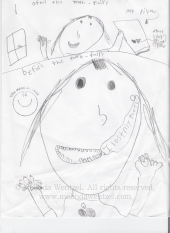
Incomprehensibly, I couldn’t remember. All I could wrap my mind around were the missed opportunities and the paltry thank-you note I had written that lay on his kitchen counter. Unopened. The one my four-year-old daughters had drawn pictures on as a way of offering thanks for his incredible generosity at Christmastime. The one that mocked my ineptitude and chided me for failing to mail it sooner…so that he might have read it…and felt in some small way more valued than perhaps he had before. The one that reminded me that words left unspoken are indeed the worst sort of words.
I’d like to think he occasionally sat on his couch and sifted through that cache of cards on a lazy afternoon, warmed by the messages scrawled within—a collection of remembrances worthy of holding close. Likewise, I hope he knows of the countless times since his death that I’ve been overcome with emotion in the card aisle of many a store, pausing in the section marked “brother” to read and reflect on what might have been—an odd yet cathartic sort of behavior.
So as one might expect, the horribleness of that day flooded my mind the very instant I heard CARDS DON’T MATTER. But instead of letting it swallow me whole, I turned my thoughts to why I had come—to find the most ideally suited messages for two special people, knowing they would feel special in turn.
Planet Mom: It’s where I live.
Copyright 2012 Melinda L. Wentzel
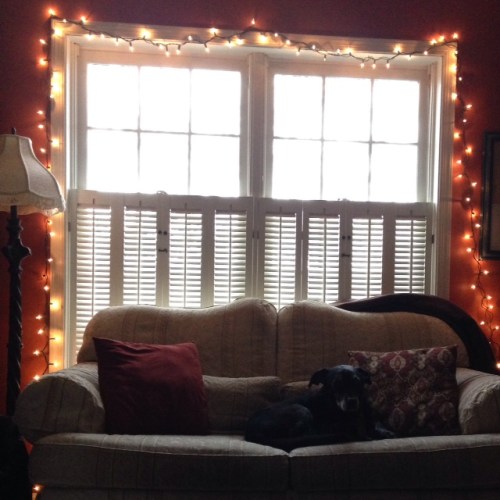 I love indoor Christmas lights. Tiny white ones, more specifically—the sort that cast a soft glow at dusk, filling a darkened room with ambient warmth, reminding me that it was totally worth risking life and limb to hang them atop windows and French doors as I foolishly balanced on a step stool, the meaty arm of a sofa and once, even upon a tall stack of pillows that were strategically placed upon said sofa. Yep. Totally worth it.
 It was painful to stand there and simply watch. To idly witness, that is, a little boy, no more than three, seized by a desperate longing to ride on the horse-drawn wagon that had circled the park more times than we could readily count in the hour or so that we waited. Again and again the team of Belgians passed us in the frigid night, pausing ever so briefly along its winding path to load and unload hoards of people who had come to this festive event—to soak in some Christmas cheer, to perhaps get a glimpse of Santa in his red, velvety suit and to feast their eyes upon the spectacle of lights that blanketed the grounds, casting a warm glow upon the darkness.